Houston Heights Home Guide to Styles and Prices
April 2, 2026
April 2, 2026
If you are thinking about buying in Houston Heights, one of the first surprises is how much home style and lot size can change your price point from one block to the next. You may love the charm of a historic bungalow, prefer the ease of a newer infill home, or want a lower-entry townhome close to popular local spots. This guide will help you understand what kinds of homes you will find in the Heights, what current price ranges look like, and how to match your budget to the kind of lifestyle and property setup you want. Let’s dive in.
Houston Heights has a long architectural history, and that history still shapes the neighborhood today. According to the City of Houston’s historic district overview, the neighborhood was founded in 1891, incorporated in 1896, and annexed by Houston in 1918, with recognized West, East, and South historic districts.
That early layout still matters when you shop for a home here. The city notes that many residential lots were originally about 50 feet wide, with larger parcels on corners and along major streets like Heights Boulevard, Yale, and Harvard. In practice, that means you can see narrow frontage from the street while still getting a lot that feels more substantial than expected.
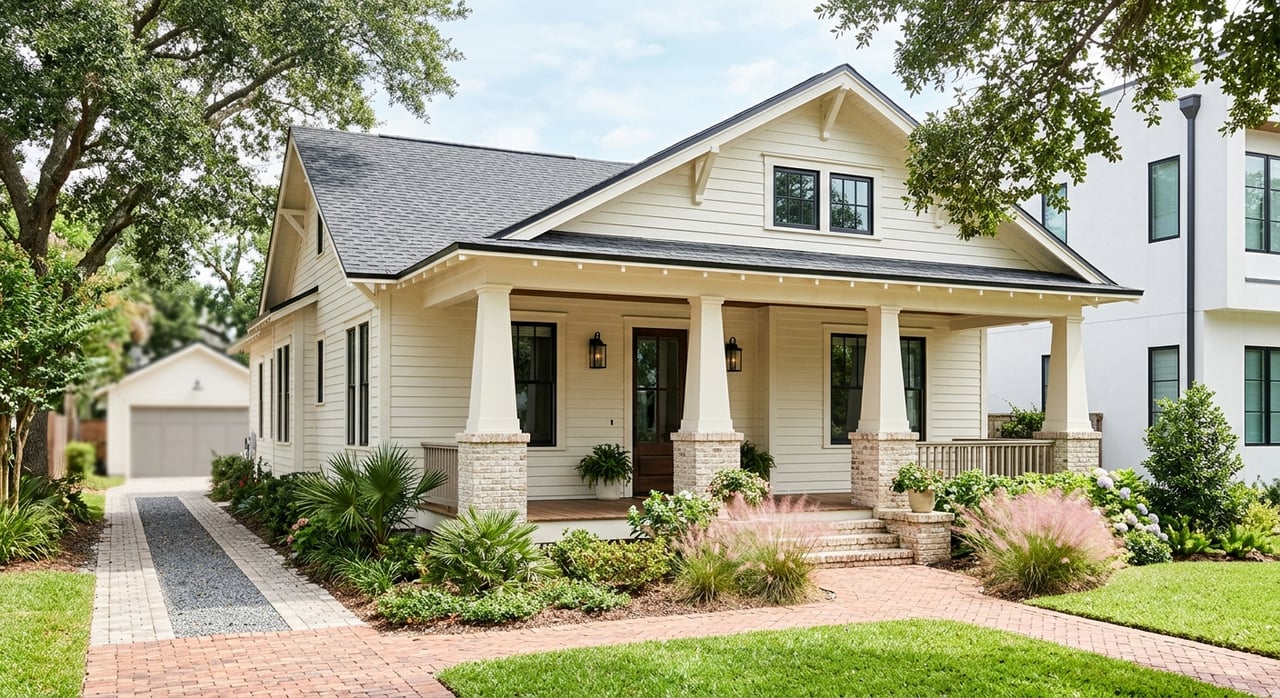
Many buyers picture Houston Heights as a neighborhood of classic bungalows, and that image is grounded in reality. The City of Houston’s architectural guidance says most historic homes here are one- or two-story single-family houses, with common styles including Queen Anne, Craftsman, Folk National, and Folk Victorian.
The bungalow style is especially tied to the Heights. In this area, bungalows are often Craftsman-influenced, with boxy forms, low-pitched roofs, wide eaves, and bracketed trim. If you want original character, mature streetscapes, and a more traditional neighborhood feel, these are often the homes that stand out first.
Not every Heights buyer wants a century-old house. A large share of newer inventory consists of free-standing single-family infill homes built on narrower lots, giving you newer systems, modern layouts, and updated finishes.
These homes often trade lot size for convenience. Based on current market examples in the research, many fall in roughly the 2,500 to 3,700 square foot lot range and often feature first-floor living, private driveways, and smaller yards rather than larger outdoor space.
Townhomes are often the more accessible entry point into the Heights market. If you want the location and convenience of the area but are trying to stay under the price of a detached bungalow or new single-family home, this is usually where your search begins.
Current examples in the research show townhomes priced from the low-$400,000s to the low-$500,000s, often on lots around 1,400 to 1,500 square feet. There are exceptions, though, including some townhouse-classified properties on larger original Heights lots.
In Houston Heights, price is not just about square footage inside the home. It is also about the lot, the street, and how the property fits into the neighborhood’s historic pattern.
The city’s design guidance says typical front setbacks are about 15 to 25 feet, and detached garages are commonly placed behind the house. That layout helps preserve the traditional look many buyers associate with the Heights, especially in historic sections.
Lot width can also be deceptive. Some streets in the West district include 33-foot-wide lots, yet the area can still feel land-rich because of depth, setbacks, and rear garage placement. For you as a buyer, that means two homes with similar asking prices may offer very different outdoor space, parking configuration, and long-term flexibility.
If you are trying to set expectations, the clearest takeaway is this: your budget often determines land as much as style. Current listings and neighborhood medians in the research show several broad tiers that can help frame your search.
At this level, you will often be looking at a townhome, attached home, or a smaller older house. Current examples include 1803 Stacy Crst listed at $425,000 and 1508 Beall St at $460,000 in the townhome category.
There are also smaller historic homes that can come in near this range. One example from the research is the 1930s bungalow at 507 W 12th St, which helps illustrate the lower end of the detached historic-home ladder.
This is where you start to see a wider mix of product types. In this range, you may find a renovated bungalow on a more traditional lot or a newer detached infill home with modern finishes.
Current examples include bungalow listings like 200 E 26th St at $775,000 and 741 E 16th St at $835,000, as well as new-construction examples such as 816 W 17th St at $799,900 and 1326 Lawrence St at $899,900. This is often the range where buyers decide whether they value historic charm and a larger lot more than newer design and lower maintenance.
Once you move past the $1 million mark, you are more likely to see premier historic addresses, larger custom homes, or highly improved properties on stronger lots. In the research, Greater Heights neighborhood market examples include 1214 Heights Blvd at about $1.295 million and 638 Heights Blvd listed at $2.199 million on a 7,500 square foot lot.
At this level, price premiums often reflect more than finishes alone. Lot position, boulevard frontage, renovation quality, and the ability to preserve or expand a historic shell can all have a meaningful effect on value.
Even when the broader market offers more choices, the historic core of the Heights can stay relatively tight. According to Realtor.com’s Greater Heights overview, there are 566 for-sale listings in Greater Heights with a median listing price of $600,000.
Within the historic districts, options narrow quickly. The same source shows East with 15 listings and a median asking price of $695,000, while South has 21 listings and a median asking price of $1.045 million. If you are targeting a very specific home style or block, that smaller inventory can matter as much as your budget.
One of the reasons buyers are drawn to Houston Heights is the ability to live with more neighborhood connectivity. But walkability is not identical everywhere, and in the Heights, it can be very block-specific.
Walk Score rates a Houston Heights 77008 location at 85 out of 100, which is considered Very Walkable. The same source reports a transit score of 46 and a bike score of 64.
For buyers, that usually translates into stronger demand near destinations such as 19th Street, Heights Boulevard, White Oak, Heights Mercantile, and the Heights Hike & Bike Trail, all referenced in the research. If two homes seem similar on paper, proximity to these kinds of amenities can help explain a pricing gap.
If you are deciding where to focus your search, it helps to be realistic about trade-offs. In Houston Heights, buyers often choose between charm, lot size, modern convenience, and price.
A simple framework can help:
The right fit depends on what matters most to you. If you want architectural character and a more traditional lot, an older bungalow may be the better match. If you prefer turnkey finishes and a lower-maintenance layout, newer infill construction may make more sense.
Houston Heights is not a one-size-fits-all neighborhood. Two homes with similar bedroom counts can have very different value stories based on lot width, block location, historic context, walkability, and renovation quality.
That is why it helps to work with someone who can help you compare not just list prices, but also the trade-offs behind them. If you are weighing your options in Houston Heights or planning a move elsewhere in the Houston area, Holly Flaskamp offers personalized guidance, clear market insight, and a relationship-first approach designed to help you move forward with confidence.
My approach to real estate goes beyond transactions—it's about building lasting relationships. I genuinely care about each and every one of my clients, treating them like family. From the moment we start working together, you’re not just a client; you’re a friend. I am truly honored and humbled each time someone entrusts me with the responsibility of being their real estate agent.